
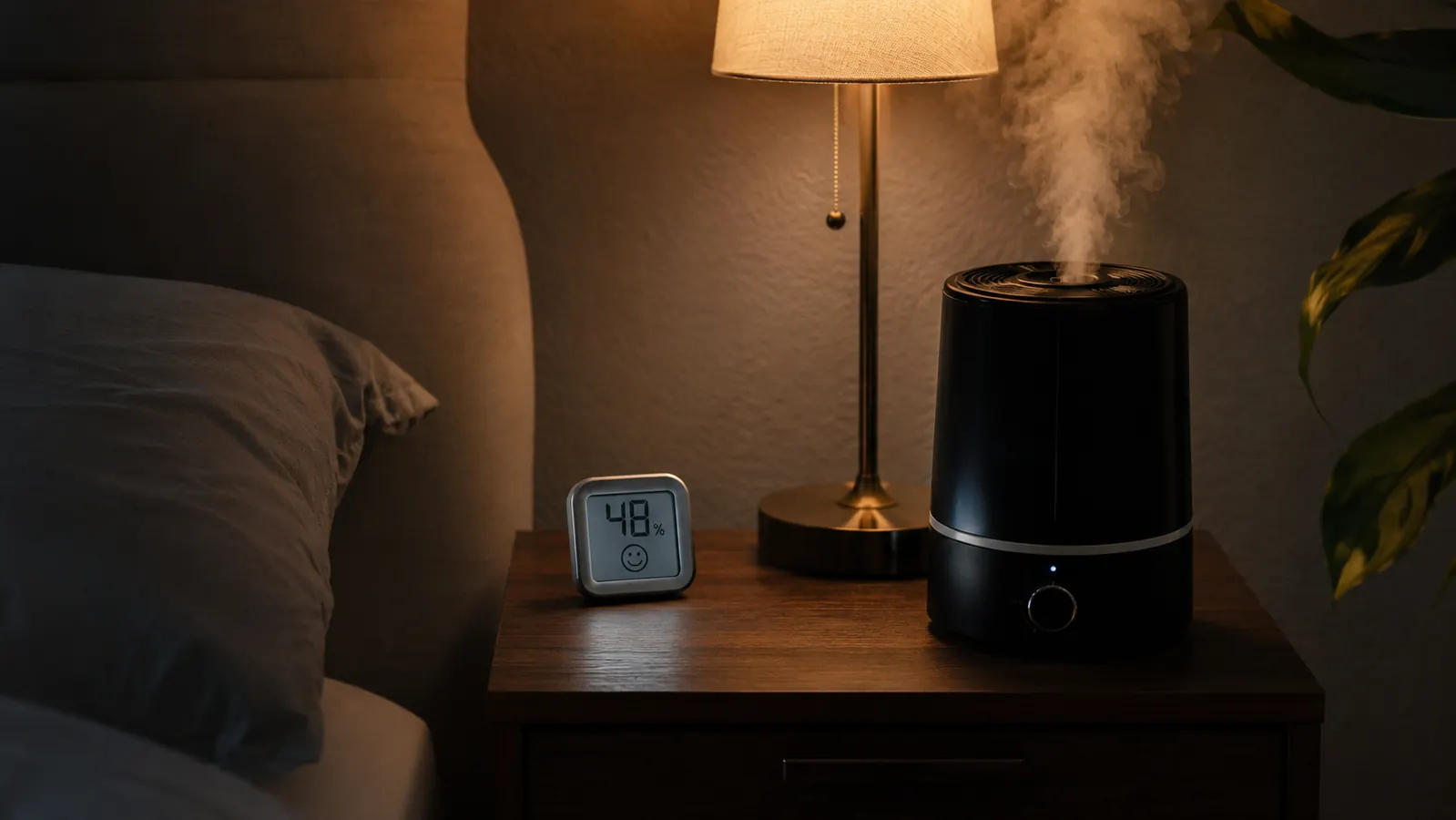
Dry air in a bedroom is not a feeling you have to just live with, it is a number you can measure and fix. I keep a Levoit cool mist humidifier running in my own bedroom for exactly that reason, and it took me longer than it should have to realize the difference between it working and just being turned on came down to a five dollar hygrometer and about twenty minutes of getting the setup right. Most people buy a humidifier, plug it into whatever outlet is open, and never check whether it actually moved the number in the room. That is the gap this guide closes, in six steps, starting before you even plug anything in.
This is not a mysterious problem, it has a number attached to it. Relative humidity is what a hygrometer reads, and most bedrooms with forced air heat running through a cold stretch sit somewhere in the twenties or low thirties percent, well under a comfortable range. Static shocks off the doorknob, cracked skin around your knuckles, a formerly quiet floorboard turning creaky, houseplants going stressed on the windowsill, these all trace back to the same low reading. The fix is not guesswork. Measure it, aim for a sensible target band, size the machine to the room, and maintain it like the small appliance it actually is.
Before you start guessing at settings, here's the machine doing the actual work in my bedroom.
I run a Levoit cool mist humidifier on the low setting most nights, filled with filtered water and cleaned on a real schedule, not the one printed on the box. See today's price and decide if it fits your room.
Amazon Check Today's Price on Amazon →Step 1: Buy a Cheap Hygrometer and Find Out What Your Bedroom Actually Reads
Before you buy a humidifier, buy a hygrometer. It is a small digital gauge, usually under fifteen dollars, and most of them read temperature and humidity together on one screen. Set it on your nightstand at roughly pillow height, not pressed against a window or sitting directly over a heating vent, since both will skew the reading toward whatever that specific spot is doing rather than what the room as a whole feels like. Leave it overnight and check it cold, first thing in the morning, before you have opened a door or run a shower nearby.
Write the number down before you form an opinion about it. I have talked to people who were positive their bedroom felt fine and were sitting at twenty two percent, and people convinced they had a swamp of a room who turned out to be at a perfectly reasonable thirty eight. Guessing is unreliable in both directions. A three day average is more useful than a single morning reading, since furnace cycles and outdoor weather can shift the number by five or six points from one night to the next.
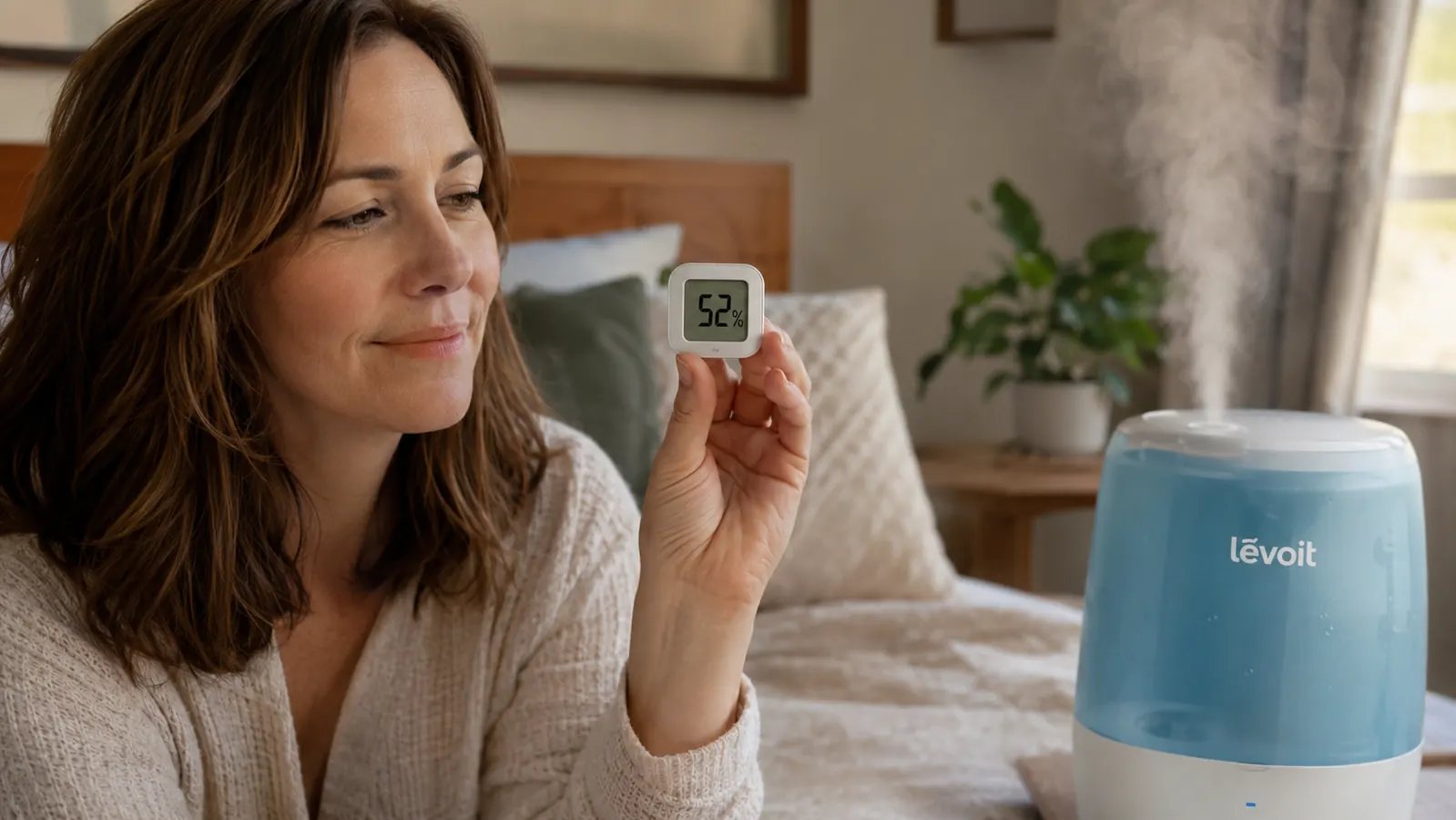
Step 2: Learn the Target Band, Roughly 40 to 50 Percent, and Why Overshooting Backfires
Once you have a real number, you need a target to aim it at. For a bedroom, roughly 40 to 50 percent relative humidity is the sensible band most home comfort guidance lands on, high enough to stop the static and cracked-skin symptoms of very dry air, low enough that you are not inviting a new set of problems. If your hygrometer reads anywhere from the low teens up into the low thirties during a cold snap, you have real room to move, and a modest humidifier running on a low or medium setting will usually close most of that gap overnight.
Overshooting is the mistake people do not expect, because more humidity feels like it should just be better. It is not. Push a bedroom past roughly 55 to 60 percent and you start seeing condensation bead on cold window glass, which drips down onto the sill and, over weeks, leaves a soft, damp patch on the wood underneath. An uncleaned tank sitting in that same damp, humid room is also exactly the environment mold and bacteria prefer, which is one more reason the target band matters and not just the total mist output. Aim for the middle of the range, not the top of it.

Step 3: Size the Unit to the Room, Not the Biggest Tank on the Shelf
It is tempting to buy the largest humidifier you can find on the theory that more capacity means fewer refills, but a unit sized for a great room will overshoot a small bedroom fast, and a unit sized for a small bedroom will never keep up in a large one. Match the machine to the square footage of the actual room it is going in, not the whole floor of the house. My Levoit humidifier holds 2.5 liters, which is a reasonable middle ground for a standard bedroom, big enough to run most of a night on a low or medium setting without a refill, small enough that it does not flood a modest room with mist in an hour.
If your bedroom is unusually large, or you are trying to cover an open loft layout, look for a unit rated for that higher square footage rather than assuming one machine covers every room in the house equally. If your room is small, a smaller tank running on low is genuinely the better fit, not a compromise. Oversized output in an undersized room is the single fastest way to sail past that 40 to 50 percent target and end up with a damp windowsill by morning.

Step 4: Place It Off the Floor, Away From the Bed, and Never Under a Smoke Alarm
Where you set the humidifier matters almost as much as which one you buy. Put it up on a dresser or nightstand rather than directly on the floor. Cool mist is heavier than dry air and tends to pool low in a room, so a floor-level unit concentrates moisture right around its own base instead of distributing it evenly, and that concentrated moisture is what actually causes local damage rather than a genuinely humid room.
Keep it a few feet from the bed itself and off any wood furniture with a finish you care about. Mist landing directly on bedding leaves it faintly damp by morning, and mist settling on an unsealed or older wood nightstand can leave a cloudy or etched mark over time, the same way a wet glass leaves a ring. A stable, water-resistant surface, tray underneath if you are not sure, is the safer default.
One placement rule that is easy to overlook, keep it well clear of any smoke or carbon monoxide alarm on the ceiling nearby. Sustained mist drifting up into a detector can cause false alarms or affect sensor accuracy over time, which is a bad tradeoff for a slightly closer nightstand outlet. Route the cord along a wall rather than across a walkway, and pick a spot near an outlet you actually use, not one that requires an extension cord snaking under the bed.
Step 5: Use Distilled or Filtered Water, and Run It Low Overnight With Auto Shutoff On
If your tap water is hard, meaning it carries a noticeable mineral load, an ultrasonic cool mist humidifier like the Levoit will fling those minerals into the air along with the water vapor, and they land as a fine white dust on nearby dark surfaces. That dust is the single most common complaint attached to this type of machine, and it is almost always a water problem, not a machine defect. Switching to distilled water, or at minimum a basic filtered pitcher, eliminates most of it, because there is little to no mineral content left to disperse.
Run the unit on its lowest setting overnight rather than defaulting to high. A low setting is quieter, uses less water per hour, and gives you far more control over hitting that 40 to 50 percent target instead of blowing past it while you sleep. Turn on the auto shutoff feature if your model has one, mine does, so the unit stops misting once the tank runs dry rather than running the ultrasonic disc against an empty reservoir, and so it will not keep pushing mist indefinitely if you oversleep past your usual wake time.
Step 6: Clean It on a Real Schedule, Not the One Printed on the Box
A humidifier tank sitting full of standing water is a place mold and bacteria can grow if it is never cleaned, and running a dirty tank means whatever is in that water gets misted straight into the room you sleep in. Empty and rinse the tank daily if you are refilling every day anyway, wipe the base dry, and let it air out during the day rather than sitting sealed and damp for twenty four hours straight. That daily habit alone prevents most of the buildup people eventually complain about.
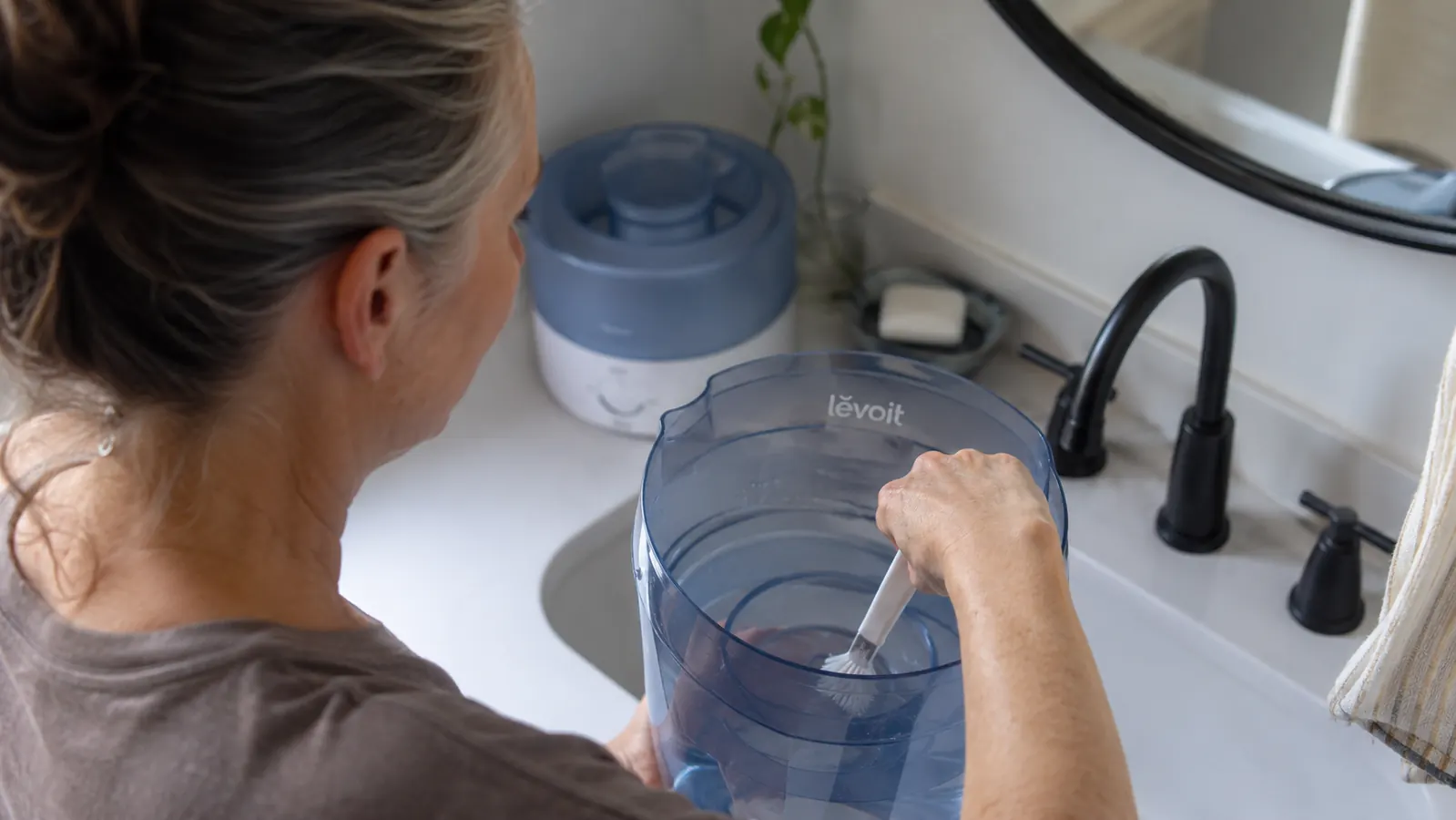
Once a week, do a real descale. Fill the tank about a quarter full with white vinegar, top it off with water, let it sit for twenty to thirty minutes, then swirl it and dump it out. Use a small soft brush, an old toothbrush works fine, to scrub the base and the ultrasonic disc where mineral film builds up fastest, then rinse thoroughly two or three times so no vinegar residue is left before you refill it for use. Wipe the whole unit dry with a clean cloth and let every part air out before you close it back up for the night.
What Else Helps
A few common failures show up over and over, and most of them trace back to one of the steps above. White dust on the nightstand means your water is too hard, switch to distilled or filtered. A faint gurgling sound usually means the tank is low or was seated on the base slightly crooked, lift it off and reset it flat. Damp windows or a soft patch on the sill by morning means you overshot the target range, drop the setting and check your hygrometer reading again after a couple of nights. If you're weighing this against a different kind of unit entirely, I broke that comparison down separately in humidifier versus diffuser, since the two solve different problems even though they look similar on a shelf.
A tank that empties well before morning usually means the setting is higher than it needs to be for the room size, or the unit is undersized for the space and working overtime to keep up. Try stepping down to low and rechecking your hygrometer after a few nights before assuming you need a bigger machine. For the full list of what a properly maintained humidifier actually does for a bedroom once you have it dialed in, I laid that out in 10 reasons a humidifier belongs in your bedroom, and if you want the unfiltered rundown of what running one is really like night after night, that is in my honest review of the Levoit humidifier.
You do not need to guess about dry air. You need a ten dollar gauge, a target number, and a machine you actually maintain instead of just plugging in.
Ready to stop guessing and start measuring your own bedroom?
The Levoit cool mist humidifier is the exact unit I sized, placed, and maintain using every step above. Check today's price and see if the 2.5 liter tank fits your room.
Amazon Check Today's Price on Amazon →