
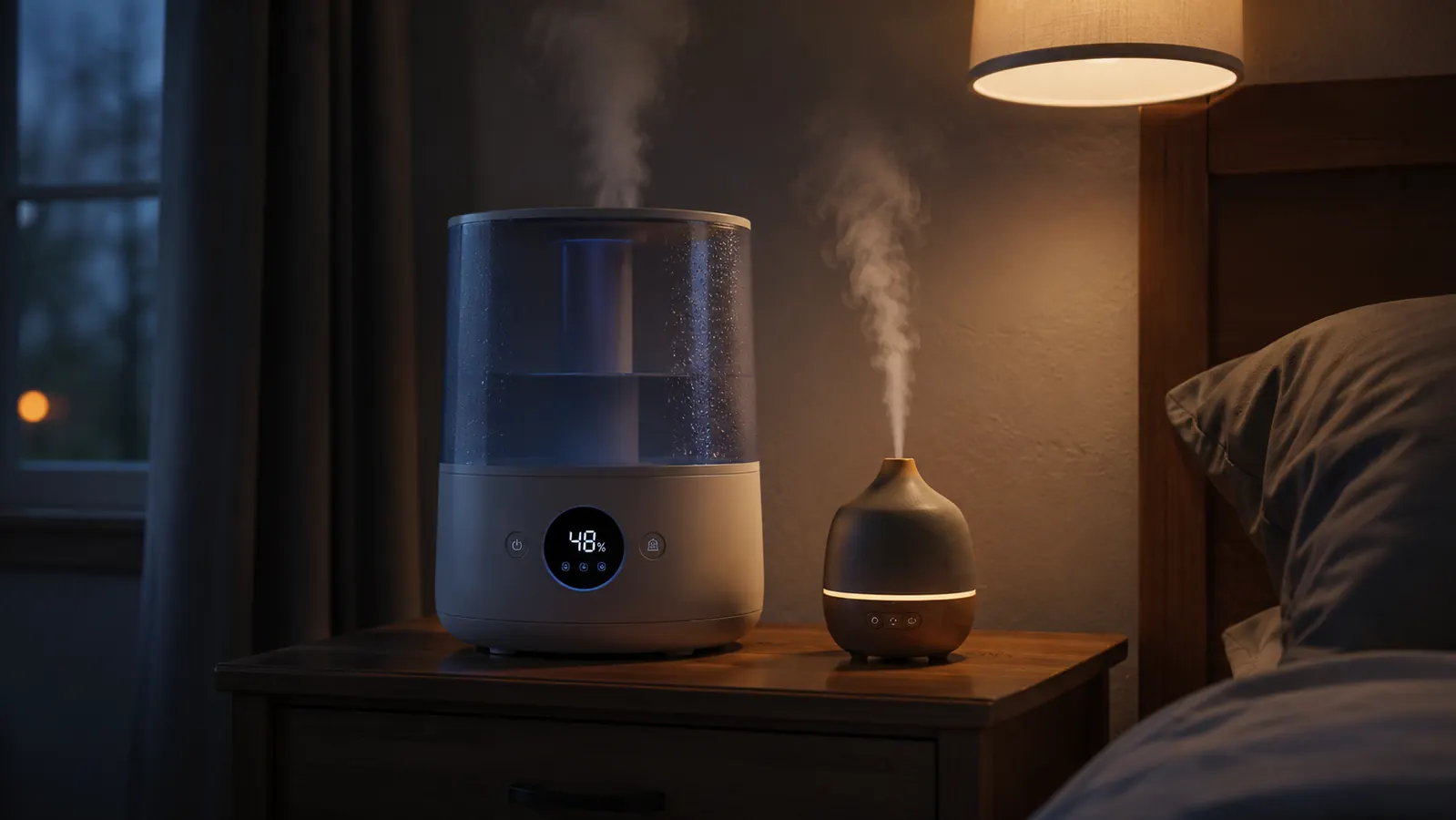
A humidifier and an essential oil diffuser can sit two inches apart on the same shelf at the store and look like siblings. Same rounded plastic body, same soft glow ring at the base, same thin stream of mist drifting up in the product photo. I get asked which one someone should buy for their bedroom about once a week, and almost every time, the honest answer is that they are shopping for two different jobs wearing the same costume. I run a Levoit cool mist humidifier on my nightstand every dry season and I have tested diffusers in that same room, so I know exactly where the confusion sets in, and where it quietly costs people money.
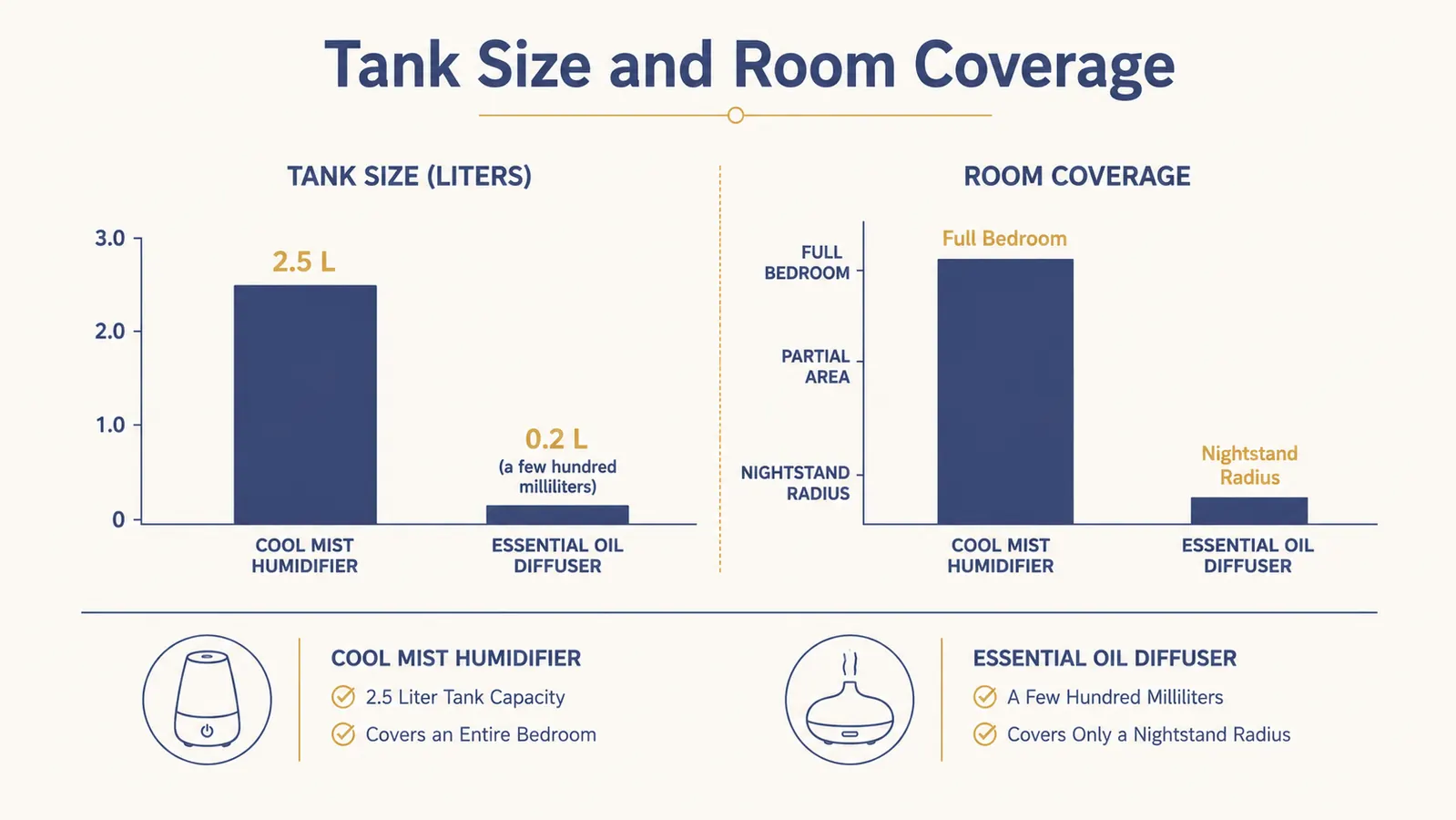
Here is the short version before we get into specifics. A diffuser holds a few hundred milliliters of water and exists to disperse scent through a small area, a nightstand or a bathroom counter. A humidifier holds liters, not milliliters, and exists to raise the humidity of an entire room. Buy a diffuser expecting it to fix dry winter air and you will get a pleasant smell and nothing measurable happening to the air itself. Buy a humidifier expecting a concentrated scent throw and you will get plain water vapor and wonder why nothing smells like anything. That mismatch is the entire reason people end up on this comparison in the first place.
They Look Almost Identical on a Shelf
Walk down the same aisle and you will see it instantly. Rounded white or wood-grain bases, a narrow mist column rising out of the top, a soft nightlight ring around the base. Manufacturers lean into that shared aesthetic on purpose, because both products get marketed as calming bedroom accessories in the same lifestyle photos. Pop the lid, though, and the difference is obvious. The Levoit's tank holds 2.5 liters, about the size of a large water bottle. A typical essential oil diffuser holds somewhere between 100 and 300 milliliters, roughly a third of a can of soda. That is not a small gap. It is the difference between a device built to change the air in a room and a device built to scent the air immediately around itself.
The mist itself looks similar too, a fine, cool vapor drifting upward, which is exactly why people assume the two do the same thing at different intensities. They do not. A diffuser is engineered to atomize a tiny reservoir of water mixed with a handful of drops of oil, just enough to carry fragrance a few feet before it dissipates. A humidifier is engineered to push measurable volumes of plain water vapor into the air continuously, over hours, enough to actually move a hygrometer reading across a whole bedroom. Same visual on the outside, completely different plumbing underneath.
What Each One Is Actually Built to Do
It helps to think about the intended output rather than the shape of the plastic. A humidifier's design brief is simple: raise the ambient humidity of a defined space and hold it there overnight, unattended, on a repeatable cycle. Everything about the Levoit, the tank size, the fan strength, the ultrasonic disc, is sized around that goal. A diffuser's design brief is completely different: atomize a tiny, precise amount of scented water into the air near the unit and shut off automatically well before the reservoir would ever be large enough to affect anything beyond that immediate radius. Neither product is a lesser version of the other. They are built for outcomes that do not overlap.
You can actually feel the gap in output if you stand next to each one running. Hold a hand a few inches above a diffuser and the mist thins out and disappears within a foot or so, which is by design, since that reservoir is only ever meant to carry a scent, not fill a room. Stand near the Levoit on a low or medium setting and the mist keeps rolling, steadily, for as long as there is water in the tank, because the whole point is continuous output that eventually raises the humidity of the air well beyond arm's reach. Neither one is malfunctioning if it behaves this way. That is exactly how each was engineered to work.
| Levoit Cool Mist Humidifier | Essential Oil Diffuser | |
|---|---|---|
| Tank Capacity | 2.5 liters | Typically 100 to 300 milliliters |
| Runtime Per Fill | Roughly two nights on the low mist setting | About 4 to 8 hours before auto shut-off |
| Changes Room Humidity | Yes, measurably, over hours of continuous use | No, output is too small to register on a hygrometer |
| Room Size It Can Serve | A full bedroom, roughly a couple hundred square feet | Only the immediate area around the unit, a nightstand or countertop |
| Safe to Add Essential Oils | Not recommended, can clog the ultrasonic diaphragm | Yes, designed specifically for oil and water mixtures |
| Noise Level | Near silent on low, light fan whoosh on medium and high | Near silent, occasional beep when the reservoir runs dry |
| Cleaning Burden | Weekly vinegar wipe-down to manage mineral scale | Quick wipe every few uses, smaller reservoir to maintain |
| Cost | Today's price on Amazon | Usually less upfront, but a narrower job to show for it |
Where the Levoit Cool Mist Humidifier Wins
If your actual problem is dry air, the kind that leaves your throat feeling scratchy or your skin tight by morning, the Levoit is doing a job a diffuser was never built for. On the low setting, that 2.5 liter tank runs mine for roughly two nights before it needs a refill, and it measurably raises the humidity in my bedroom over the course of a season, not just for the hour I happen to be standing near it. That is the core distinction. A humidifier's entire design goal is to raise the water content of the air in a defined space, and the tank size, the fan, and the ultrasonic disc are all sized to do that continuously, night after night, without you having to think about it.
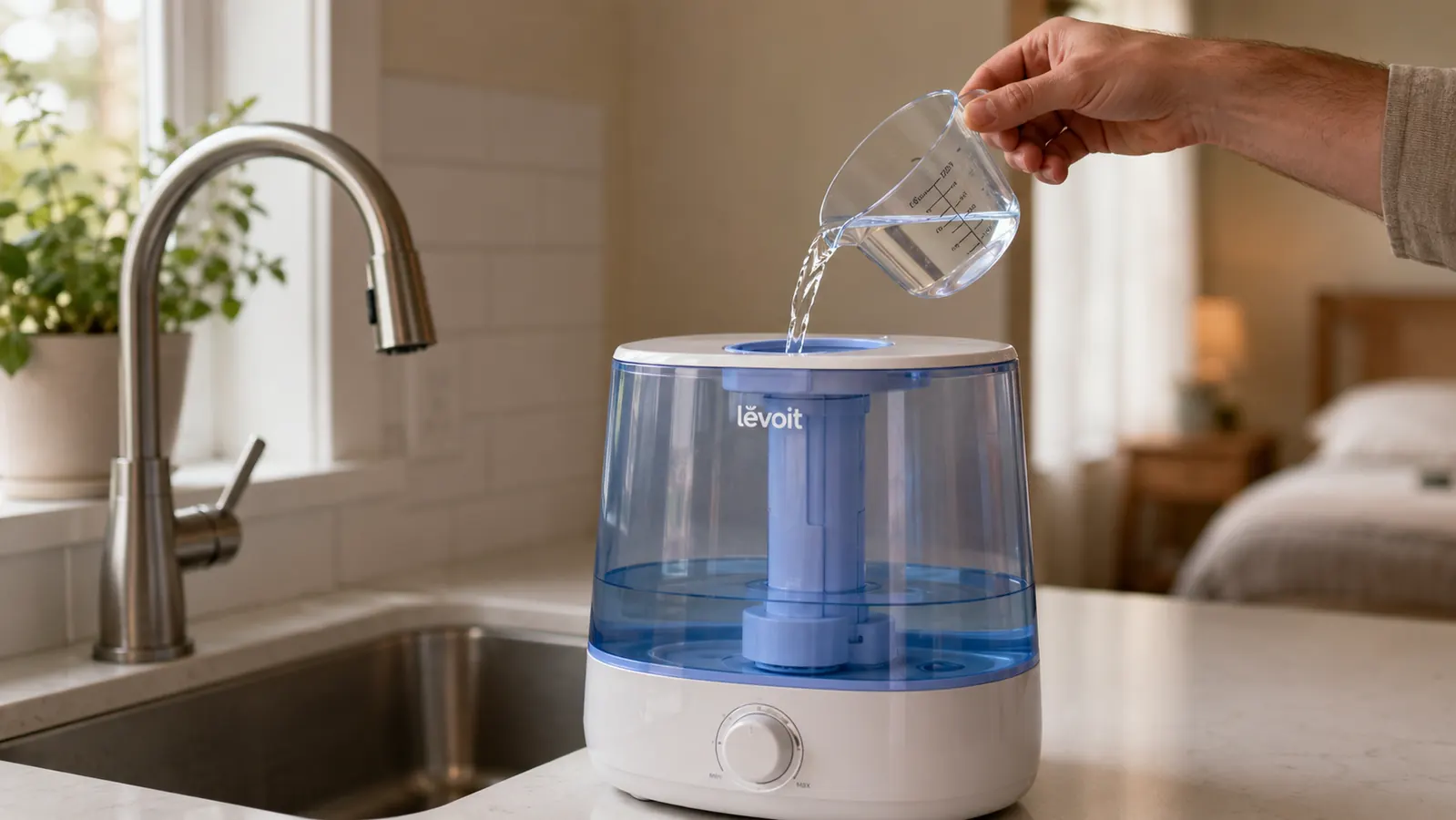
The Levoit also covers a real room, not just a nightstand radius. It is built for a bedroom in the range of a couple hundred square feet, which means it is still working whether you are standing next to it or asleep on the far side of the room. The top-fill design and the 360-degree rotating nozzle make it easy to live with too, you can point the mist away from furniture or a lamp without moving the whole unit, and refilling is a quick trip to the sink rather than a fussy pour into a narrow opening. None of that matters if all you want is a nice smell for twenty minutes before bed. It matters enormously if you are trying to fix an actual dry-air problem that repeats every single night of the season.
It also holds up to being ignored a little, which matters for anyone with an irregular schedule, shift work, early starts, travel weeks. Let the tank run closer to empty than you meant to, skip a cleaning while you are away, and the Levoit still comes back to life the next time you fill it. A diffuser's tiny reservoir gives you far less margin for that kind of forgetting, since it is designed to be topped off constantly by nature of how little it holds.
Where an Essential Oil Diffuser Wins
None of this makes a diffuser pointless, it just means it is solving a narrower problem. If what you actually want is a specific scent, lavender before bed, something citrus in the morning, a diffuser is built exactly for that and a humidifier is not. Diffusers are also designed to have oils added safely, with a reservoir and atomizing mechanism made to handle the oil and water mixture without gumming up. Most cool mist humidifiers, including the Levoit, are explicitly not designed for that. Adding oils to an ultrasonic humidifier's tank can clog the diaphragm and shorten the life of the unit, so if scent is the actual goal, forcing a humidifier into that role is the wrong move, not a shortcut.
Diffusers also tend to cost less to run day to day, since a few hundred milliliters of water and a handful of drops of oil is a small ongoing expense compared to filling a multi-liter tank every other day. If your bedroom already sits at a comfortable humidity and all you are chasing is ambiance and scent, a diffuser gets you there without any of the maintenance that comes with a humidifier, no weekly vinegar wipe-down, no mineral scale to manage, no tank to lug to the sink. It is a smaller, simpler device built for a smaller, simpler job, and there is nothing wrong with buying exactly that when it is what you actually need.
A diffuser also makes more sense in small, closed spaces where a full humidifier would be overkill anyway, a bathroom counter, a desk at a home office, a car cup holder version for a commute. Those spots do not have the square footage for a humidifier's output to matter, and running one there would mean refilling constantly for very little benefit. A diffuser's small reservoir and short runtime are actually the right match for a small space, not a limitation. Matching the device to the size of the room, rather than defaulting to whichever one looks nicer on the shelf, is really the whole decision.
Chasing dry-air relief from the wrong device?
A few hundred milliliters of scented water was never going to change the humidity of a whole room. See today's price on the Levoit cool mist humidifier and what's actually in the box.
Amazon Check Today's Price on Amazon →
Can You Just Add Oils to a Humidifier?
This is the question I get most once people understand the tank size difference. Technically some humidifiers on the market are marketed as oil-compatible, usually ones with a separate small tray designed to hold a few drops away from the main water reservoir. The Levoit is not built around that feature, and running straight essential oils through an ultrasonic disc meant for plain water is a common way to gum up the mechanism over time, which shortens the life of the unit and can void the manufacturer's guidance. If scent matters to you as much as moisture does, the honest answer is to run both devices, a humidifier for the room's actual air, a diffuser for the scent, rather than trying to make one product do both jobs poorly.
Who Should Buy Which
If you are waking up with a dry throat, static hair, or a bedroom that just feels parched by morning, that is a humidity problem, and only a real humidifier addresses it. I wrote up what four months of nightly use with this exact Levoit unit actually looked like, tank refills, noise level, mineral scale and all, in my full long-term humidifier review, and I go further into the tradeoffs, including where it fell short, in my honest review written from a light sleeper's perspective. Both are worth reading before you buy if you want the unfiltered version rather than the marketing copy.
If your bedroom air already feels fine and what you actually want is a calming scent to wind down with, a diffuser is the right, cheaper tool, and buying a humidifier for that job alone is more device than you will ever use to its full capacity. But if you have bought diffuser after diffuser hoping one of them would finally fix the dry-air feeling, stop. That was never the job it was built for. The tank size alone tells you everything you need to know: a few hundred milliliters was never going to change the humidity of a whole room, no matter how nice it smelled while it tried.
Solve the actual problem, not the one that just smells nice
If dry bedroom air is the real issue, a diffuser was never going to fix it. Check today's price on the Levoit cool mist humidifier and see if it fits your room.
Amazon Check Today's Price on Amazon →