
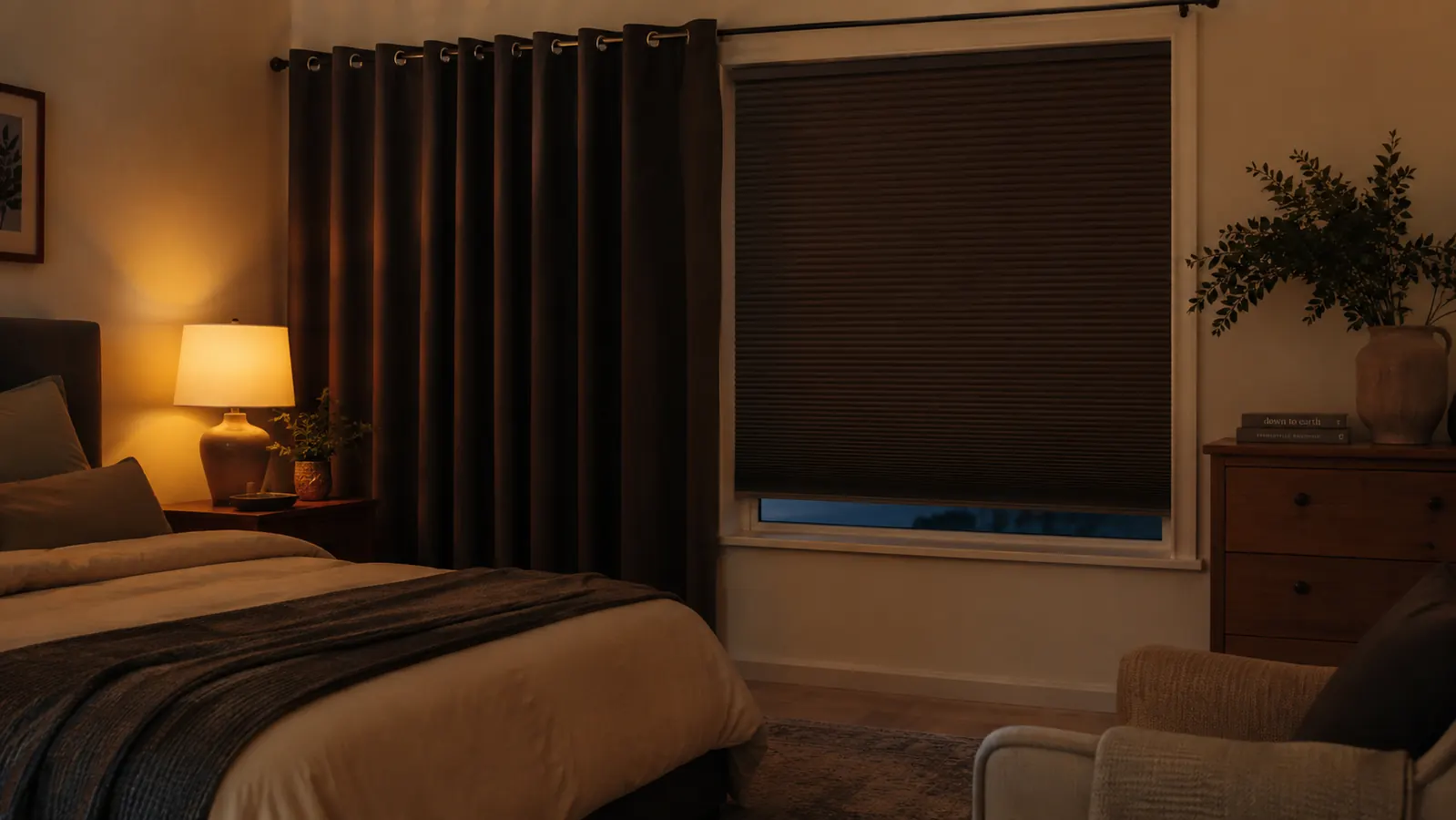
If you've spent any time comparing bedroom blackout options, you've probably landed on this exact question: do you hang heavy blackout curtains, or do you install blackout blinds that sit inside the window frame? I've tested both over the years I've spent writing about sleep gear, and most recently I lived with a pair of NICETOWN thermal insulated blackout curtains for months on a west-facing bedroom window that used to glow orange every evening. My partner keeps an irregular schedule, home and trying to sleep at odd hours some weeks, awake most of the night on others, so I needed a real answer about which option actually gets a room dark, not just a marketing claim on a product page. Short version: for most bedrooms, curtains beat blinds on total darkness and cost, and the NICETOWN panels are the pair I still have hanging. Blinds pull ahead in a narrower set of situations, and I'll walk through exactly where.
That doesn't mean blackout blinds are a bad choice, they're just built for a different job. A blind sits inside or flush against the window frame, so it blocks light at the source, which sounds ideal until you notice the gap where the frame meets the wall. A curtain panel, cut wide enough and hung close to the ceiling, overlaps the entire window plus several inches of wall on each side, which is a big part of why grommet-top curtains like the NICETOWN panels tend to out-block blinds when you actually test them side by side in a dark room. Below is how the two options compare on the specifics that matter for sleep, not just how they look on the window. I also want to be upfront that neither option is inherently "better" in the abstract, they're built to solve slightly different problems, and the honest comparison only works once you look at how each one behaves on a real window instead of a spec sheet.
How I Actually Compared Them
I didn't want to guess at this, so I ran a simple test on the same bedroom window, first with a cellular blackout blind mounted inside the frame, then a few months later with the NICETOWN curtains hung on a rod extending well past the frame on both sides. Same window, same streetlight outside, same time of night. With the blind fully closed, a thin line of light still showed along both edges where the frame met the wall, faint but enough to notice once my eyes had adjusted to the dark. With the curtains closed, holding a phone flashlight directly behind the fabric from outside showed almost no beam coming through, and there was no edge glow at all.
I also tracked how each option handled everyday use over a few weeks: opening and closing daily, catching a draft from the AC vent, and how much dust collected on each one. The blind's slats picked up a visible layer of dust within about three weeks that needed wiping down by hand. The curtain fabric didn't show it as quickly, and when it finally did, a cold machine wash handled it in one cycle. None of this is a lab test, it's just what actually happened in my own bedroom, but it's the kind of detail a spec sheet never tells you.
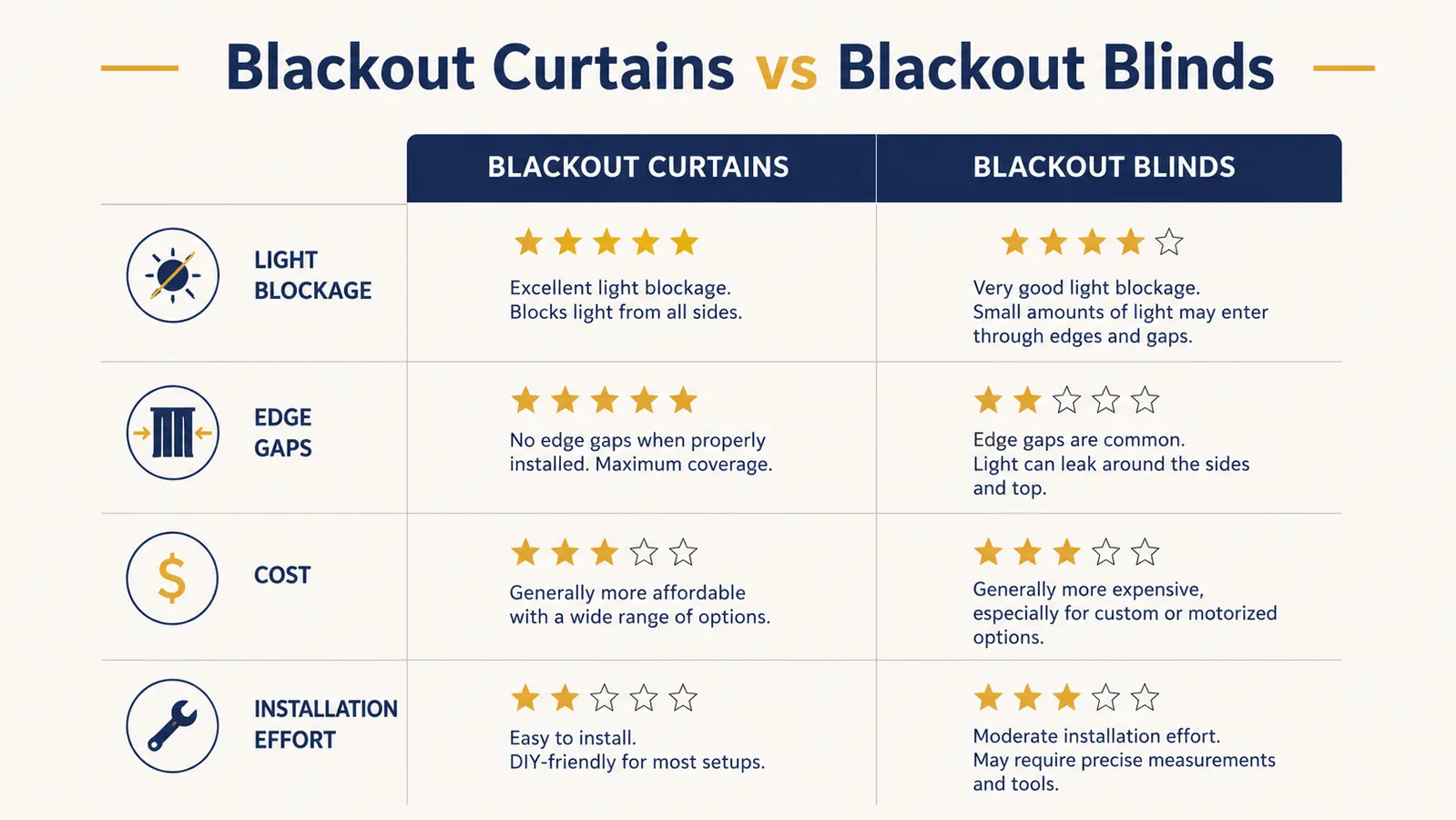
| NICETOWN Blackout Curtains | Blackout Blinds | |
|---|---|---|
| Light blockage in the center of the window | Near-total in a dark grey panel, verified with a phone flashlight held directly behind the fabric with no visible bleed | Very good when fully closed, though a faint glow can still show through fabric-based cellular blinds |
| Light gaps at the edges | Minimal, since the rod extends 6 to 8 inches past the frame on each side and the panel overlaps the wall | Common, since blinds are cut to the exact window opening and the frame itself becomes a light channel |
| Installation effort | Two screws per bracket, rod slides on, most windows finished in under 15 minutes | Usually requires precise inside-mount drilling or an outside-mount bracket kit, plus leveling |
| Renter friendly | Yes, curtain rods use small screw holes that patch easily, or tension rods that need no drilling at all | Only with an outside-mount kit, and most landlords are stricter about anything touching the window frame itself |
| Thermal effect on the room | Adds a noticeable insulating layer since the fabric hangs a few inches off the glass and traps a pocket of air | Some help from cellular styles, but slat blinds add little to no insulation |
| Noise dampening | Heavy woven fabric absorbs some street noise and softens echo in the room | Hard slats or thin fabric add almost no sound absorption |
| Cost for a standard bedroom window | Around $12 to $20 for a two-panel set | Often $40 to $150 or more for a made-to-measure blackout blind |
| Cleaning | Machine washable on cold, tumble dry on low | Wipe down with a damp cloth, most cannot be washed and dust collects in the folds or slats |
| Lifespan | Several years of daily open and close before the grommets loosen or the fabric fades | Several years as well, though the lift cord or motor in cordless models is usually the first thing to fail |
Where NICETOWN Blackout Curtains Win
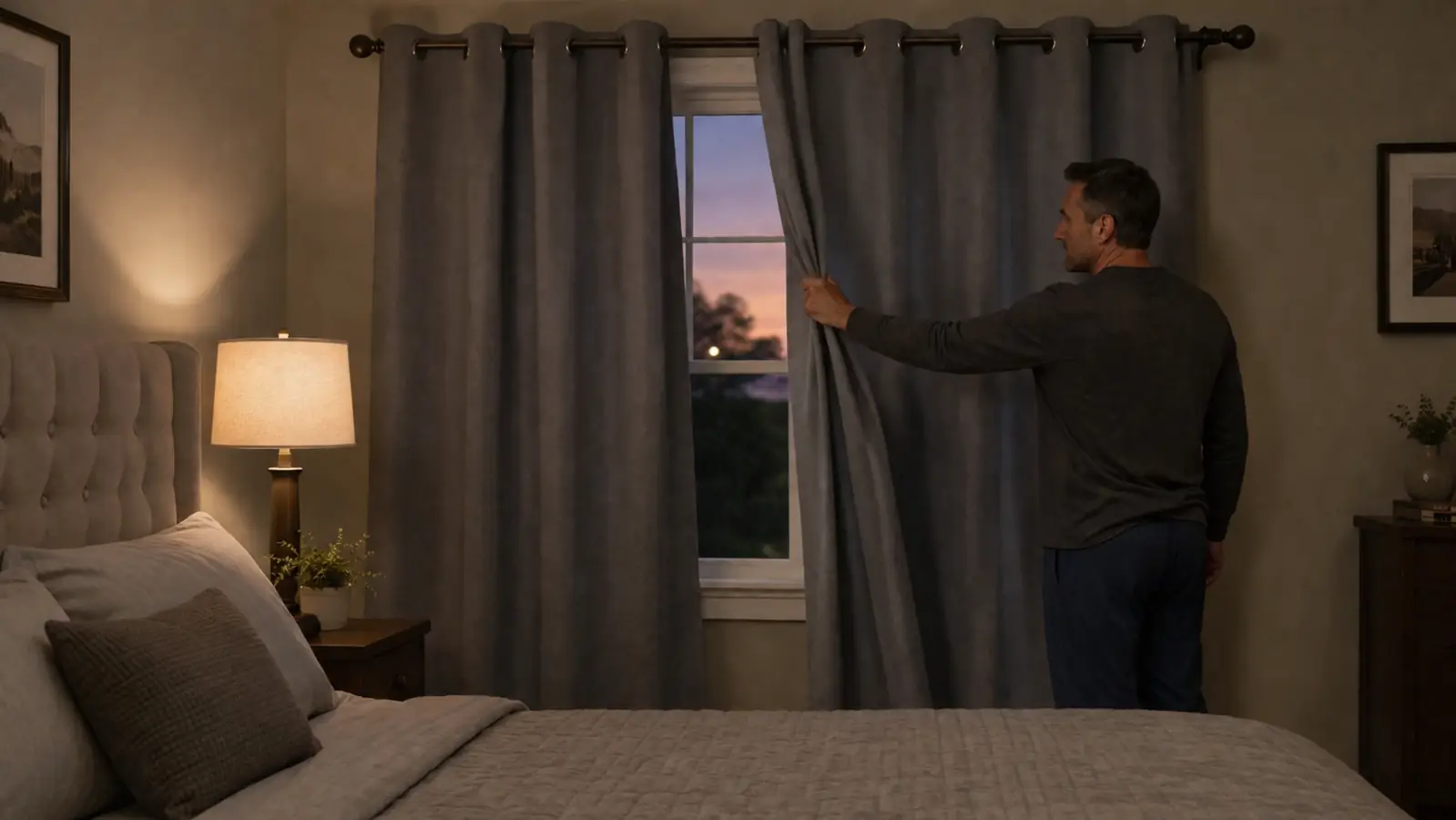
The biggest reason I keep recommending NICETOWN over a blind is coverage. Because the panels are cut wider than the window and I hung the rod high and past the frame on both sides, there's no straight light path anywhere along the edges or the top. On that west-facing window that used to light up orange every evening, switching to the NICETOWN curtains kept the room genuinely dark from late afternoon straight through morning, which matters a lot if you're trying to sleep during daylight hours. A blind, even a good one, is limited to the width of the frame it's mounted in, and any gap between that frame and the surrounding wall becomes a thin bright line, especially noticeable once your eyes have adjusted to a dark room. That kind of edge-to-edge coverage is the whole reason a curtain panel can out-block a blind that technically has a higher light-blocking rating on paper, since the rating only describes the fabric or slats themselves, not what happens at the seams where the window meets the wall.
Cost and commitment are the other factor. A two-panel set of NICETOWN curtains runs a fraction of what a made-to-measure blackout blind costs, and if you move or change your mind about the room, you take the rod down and patch two small screw holes. I've done exactly that in two different apartments. Blinds, especially inside-mount ones, are cut to a specific window and don't transfer cleanly to a new home, if they transfer at all. If you're renting, or you're not fully sure this will be your bedroom long-term, that difference alone tends to settle the decision in favor of curtains.
There's also the insulation and noise side, which surprised me more than I expected going in. Because the curtain fabric hangs a few inches off the glass, it traps a thin pocket of air that adds a real insulating effect, and the heavier weave absorbs a bit of street noise too, softening the room instead of leaving it acoustically bare. A slat blind does almost neither of these things. If your window faces a busy street or a drafty exposure, that's a second, quieter reason to lean toward curtains over blinds.
Where Blackout Blinds Win
None of this means blinds don't have a real place. If you want to control light without adding fabric to the wall at all, a cellular blackout blind mounted inside the frame keeps the window looking clean and minimal, which matters in small rooms or shared spaces where floor-to-ceiling fabric feels heavy or closes the room in. Blinds also don't billow in a draft the way a curtain panel can near an open window, and in a small apartment where every inch of wall space counts, a blind sitting flush in the frame doesn't eat into the room the way a curtain rod extending past the window does.
Blinds also win if you want finer control over how much light comes in during the day. Top-down, bottom-up cellular blinds let you let light in from the top of the window while keeping the bottom blocked, something a curtain panel can't really do without physically pulling it partway across by hand. If your bedroom does double duty as a reading nook or a spot to work near natural light, that flexibility is worth the added cost. For a room used strictly for sleeping in the dark, it's not something you'll reach for often.
One more point in favor of blinds: they don't need extra wall space for a rod, so in a very tight room, or one with furniture pushed close to the window, a blind can be the more practical fit even if it isn't the darkest option available. It's a real tradeoff, not a small one, if square footage is genuinely tight and every inch around the window is already spoken for.
A curtain that overlaps the wall beats a blind that fits the frame perfectly, because the frame was never the problem.
Stop Losing the Edges: Check Today's Price on the NICETOWN Panels
If total darkness across the whole window, not just the center of it, is the actual goal, the NICETOWN Thermal Insulated Blackout Curtains are the simplest way to get there without a drill or a custom blind order.
Amazon Check Today's Price on Amazon →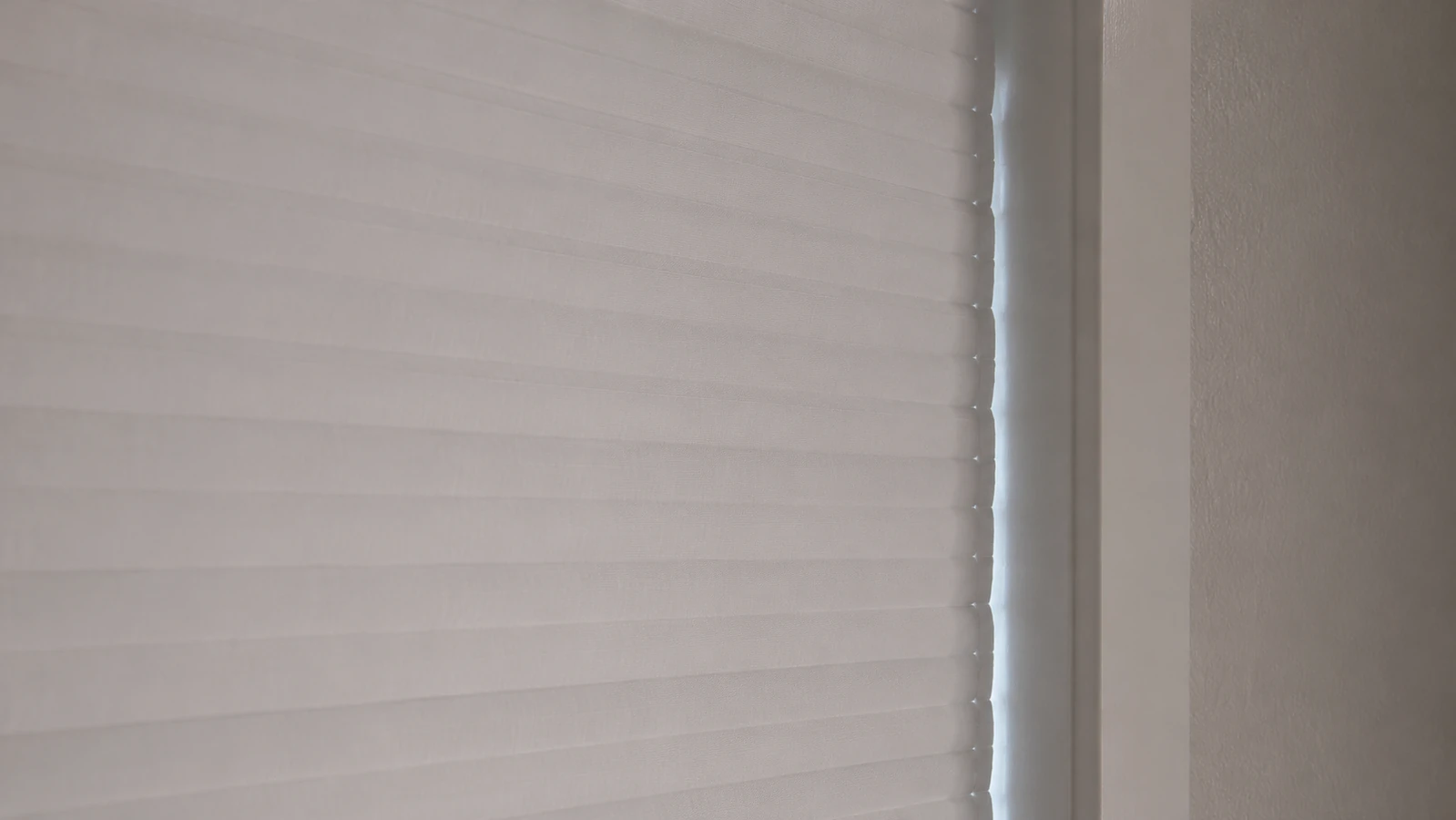
Who Should Buy Which
If you're renting, working with a tight budget, or you just want the darkest possible room with the least hassle, go with curtains, and NICETOWN is the pair I'd point you to first since it's the one I've actually lived with on a problem window. If your window has an unusual mechanism, like one that cranks open outward and a curtain rod would sit in the way, or you specifically want to let morning light filter in from the top while keeping the bottom of the window dark, a blackout blind is worth the extra cost and the more involved installation. I'd also lean toward blinds if you're in a small studio where a rod extending past the window frame genuinely eats into usable space. For a deeper look at how these curtains actually performed over time in my own bedroom, I wrote up the full details in my long-term curtains review and, a year later, in my full honest review.
If you're still on the fence, think about how often you'd actually use a blind's daytime light control versus how badly you need the room dark at night. Most people shopping for blackout anything are solving a nighttime problem first. In that case, the wider overlap and lower cost of curtains, and specifically the fit and finish I got from the NICETOWN panels, is the safer bet. Save the blind for a window where a rod genuinely can't work, not as a default first choice.
One last thing worth naming plainly: cost isn't just about the sticker price, it's about how expensive a mistake is to fix. A $15 pair of curtains that doesn't fully block light is a cheap lesson, you swap the rod position or add a second panel and move on. A $120 blind that leaves the same edge gap is a much harder mistake to walk back, since it's already cut to that window and returning a custom order isn't always simple. That asymmetry is part of why I default to recommending curtains first for anyone who hasn't already tested a blind in their own room.
The Flashlight Test That Actually Matters
Hold a phone flashlight behind the fabric in a dark room. If you can see the beam, it isn't blackout. The NICETOWN panels are the pair that passed that test in my own bedroom, and they're still hanging.
Amazon See Today's Price on Amazon →